

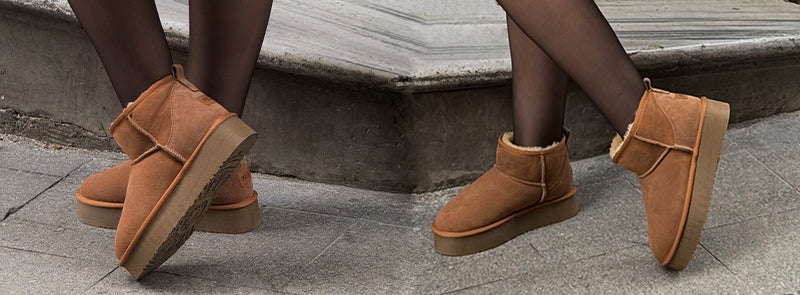
You’re in a shoe store or browsing an online site. That boot in the window catches your eye: shiny, smooth, and looking “premium.” The label says “genuine leather,” the salesperson says “it’ll last a lifetime”… but something inside you whispers, “If it’s this cheap, something’s fishy.”
You’re right. Today, synthetic materials don’t just “look like leather”; they also try to imitate how leather behaves. What’s more, some synthetic leather manufacturers deliberately add to the confusion by creating leather-like scents and surface textures.
But genuine leather is more than just an appearance. It is a “living” material that reveals itself through its pore and fiber structure, interaction with heat, reaction to water, creasing behavior, cross-sectional texture, and tanning chemistry.
At Derimarket, with our brands Pegia and Cool Moon, we use furs produced at our own sheepskin tannery and certified leathers sourced from other tanneries. Since we see the details of genuine leather and sheepskin in production every day, after reading this article written with our expertise, whether you’re shopping in-store or online, you’ll be able to identify a shoe’s material with complete confidence.
1) Reading labels: Look at the categories, not the wording
Checking the label is a starting point, but it is not enough on its own to make a decision. That’s because “leather” is a whole universe: the same word can describe both a very high-quality material and a very poor leather layer.
Leather symbols (general guide):
- Animal hide shape: leather component (often genuine leather)
- Diamond / lozenge: synthetic
- Square: textile
Glossary of terms (the really important part):
- Full Grain (Full Grain): The very top layer of the leather; natural pores are preserved. It is the layer that ages best, develops a patina, and breathes.
- Top Grain: The top layer is preserved, but the surface may have been “corrected.” It is high quality; it may not show as much natural texture as full grain.
- Split / Suede / Split Leather: The lower layers of the leather; this is where suede comes from. When processed properly, it can be excellent, but it is not in the same class as “full-grain leather for life.”
- Bonded Leather: Leather fibers/dust pressed together with a binder. It “contains leather” but does not behave like leather; over time, it tends to crack like a film.
- PU / PVC / Faux / Vegan Leather: Synthetic. Some can be made to a high standard, but they are not “leather”; their breathability and aging behavior are different.
- Genuine Leather: The most misunderstood term. “Genuine” often means only “made from real leather”; it says nothing about quality on its own. What determines quality is the layer of the leather and how it is processed.
The goal here isn’t “run away when you see the word genuine”; it’s to learn to look for details about the layers, tanning, lining, and craftsmanship in the product description, even when it says genuine.
2) Pore analysis: Leather doesn’t like to be flawless

Genuine Leather is an animal’s skin; like human skin, it has a random and heterogeneous structure. Think at a microscopic scale: fiber bundles aren’t equally dense at every point. That’s why it’s normal to see slight changes in tone, very faint vein-like marks, and tiny natural markings on the surface.
Signs that raise suspicion:
- The surface is as flawless and uniform as “plastic film”
- The pore patterns repeat (as if the same marks continue at the same intervals)
- The texture feels like it has been “embossed”
Natural signs of Leather:
- The pores are irregularly distributed
- There are very slight variations in texture
- It “settles in” more beautifully with age (patina)
In short: Imperfections aren’t always bad in Leather. Sometimes “too much perfection” is a bigger red flag.
3) Smell test: The difference between organic structure and polymer chemistry
Smell is the most basic but quickest test. That’s because the smell of Genuine Leather is an organic mix of tanning, oiling, and finishing chemicals. With synthetics, the smell is often the “sharpness” of manufacturing chemicals.
- With synthetics, when you open the box, you may notice a nose-stinging smell resembling “new plastic,” “a new car interior,” or strong adhesive.
- Genuine Leather has a more “earthy/organic” note. Rather than being unpleasant, it gives off a more natural character.
Note: If some products have been stored for a long time, the smell of the box may change. So the smell test alone isn’t conclusive; it should be considered alongside other findings.
4) Heat test: Leather behaves like skin
Place your hand on the shoe’s surface and wait a few seconds.
- Genuine Leather “takes in and balances” heat more naturally. The spot you touch shouldn’t stay “cold” for long.
- Synthetic film surfaces can feel “cold and lifeless”; the warmth of your hand stays on the surface instead of penetrating it.
This test is especially useful in a store because it requires no equipment.
5) Cross-section check: Fiber structure doesn’t lie
One of the clearest ways to tell Leather from synthetic material is to look at the cross-section of the Leather. Check areas such as the edges of the stitching, the inside of the lace holes, and the edge of the tongue.
- With Genuine Leather, you can see a fibrous, suede-like, organic structure in one piece in the cross-section.
- With synthetic leather, the “fabric backing + plastic film” layers are usually clearly distinguishable. The cross-section looks more “flat and layered.”
This isn’t a “microscopic examination,” but it’s the same principle in a form visible to the naked eye: A bundle of fibers or a film layer?
6) Water drop test: How does the porous structure respond?
Don’t do this test in the store; consider it only after buying the product, under suitable care conditions and on appropriate surfaces.
- On genuine leather, (especially if the finish isn’t too sealed) water may be absorbed slightly after a short time, causing a small darkened spot; the mark usually fades as it dries.
- On synthetics, water droplets slide off more like they’re “on glass”; there’s no absorption.
Important nuance: Many high-quality leathers may be treated with a finish or protective coating to repel water. In that case, water may bead on genuine leather, too. So this test is not conclusive on its own; it simply helps you assess how the material behaves.
7) Crease (wrinkle) test: Leather’s natural response
Press lightly on the surface with your finger or bend the toe area just a little.
- Genuine leather develops very fine, natural creases, like skin. The marks don’t disappear instantly; they fade gently.
- Synthetics either cave in like a balloon or form stiff creases like “cracked film.” Some synthetics imitate leather well at first, but over time leave permanent crease marks on the surface.
This test is especially useful for ruling out products that look “too shiny and smooth.”
8) Lining and insole: The real story of foot health is on the inside
Even if the outer surface is genuine leather, synthetic materials inside increase the risk of sweaty, smelly feet. So ask:
“Is this shoe made of leather only on the outside, or is there a breathable system inside, too?”
- Natural linings such as leather lining / sheepskin create a more balanced environment inside the shoe.
- Synthetic glossy linings reduce costs but compromise foot comfort.
Also look for these signs on the insole side:
- neat, secure placement
- clean workmanship
- no rough glue residue
9) Stitching, finishing, and production discipline: Craftsmanship is as telling as the material

Genuine leather is an expensive raw material. That’s why a good manufacturer doesn’t use it with a “fast production” mindset. The stitching, thread quality, and cleanliness of the seams often offer clues about the quality of the material, too.
Look for these signs:
- Is the stitching straight, with even spacing?
- Are there skipped stitches at the corners?
- Is there any visible glue overflow where the sole meets the upper?
- Is the edge paint smooth, or bubbly?
These points answer not only “Is it leather?” but also “Is this leather well-made?”
10) Tanning method: Chrome or vegetable; what does each tell you?
Now here’s the real “expert” part. Leather isn’t just leather; what makes it leather is stabilizing the raw hide through tanning. The two most common approaches:
Chrome tanning:
- Can be softer and more flexible
- Can be more resistant to water
- Widely used in everyday shoes
- Offers a wide variety of dyes and finishes
Vegetable tanning:
- Tanned with vegetable tannins
- More prone to developing a patina over time
- Offers a more “natural” character
The right approach here isn’t “one is good and the other is bad.” The right question is:
“Where and how will I use these shoes, and what kind of leather performance do I want?”
At Derimarket, what confirms quality isn’t just the “type of tanning”; it’s also the grade of leather selected, the breathability balance of the finish, the lining structure, and the production standard.
The “fire test”: Think of it like a lab test; don’t try it at home.
You can include this topic in the guide, but with clear safety guidelines:
- Testing it on the product permanently damages it.
- Synthetic materials can release toxic fumes; they’re risky indoors.
- This test is only meaningful with a sample piece and a controlled environment.
Why is genuine leather still considered an “investment”?
Distinguishing genuine leather isn’t just about “not getting fooled”; it also means foot health and longevity.
- Breathable: It balances the climate inside the shoe (reducing the sweat-odor cycle).
- Adapts: As you wear it, it gets to “know” the shape of your foot better.
- Repairable: Scratches, dyeing, care, refurbishment… leather ages, but it doesn’t become trash.
- Long-lasting: With proper care, it can keep its shape for years.
How can you overcome the “I can’t touch it” problem when shopping online?
You can’t feel it online, but you can find information.
- Does the product description clearly specify the leather layer (full grain/top grain/suede/split) and lining?
- In close-up photos, does the texture look like a “repeating pattern” or natural?
- Are the stitching, edge finishing, and sole attachment clean?
- Is the brand an expert in this field, or a marketplace seller that “sells everything”?
This is where brands with expertise in leather and sheepskin, such as Derimarket, have an advantage: product descriptions are clear, and material standards are consistent.
One last thing: Learn to read leather, and you’ll no longer “blindly trust the label.”
By the end of this guide, the goal is this: when you pick up a shoe, you won’t just ask, “Does it look good?”
Look at the pore distribution, the fibers in the cross-section, how it creases, the breathability of the lining, and what the tanning process tells you.
A conscious consumer doesn’t buy the most expensive option; they buy the right one.
We at Derimarket always follow the principle of “genuine materials + clean craftsmanship + proper use.” Because when leather is treated properly, it’s more than just a product; it’s a long-term companion.


