

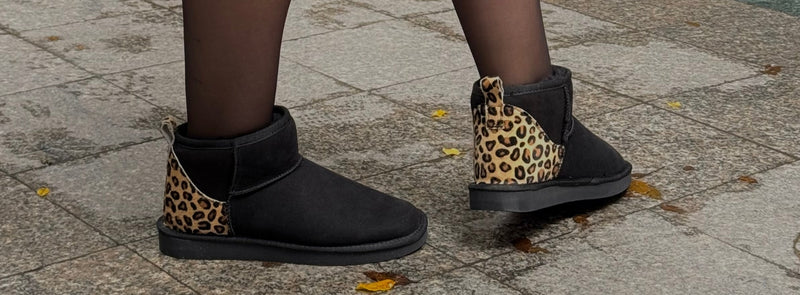
For stylish women and men, winter means putting on their boots and heading out. The feeling you get when you put on those beloved Pegia Suede boots or Cool Moon snow boots - “strong, warm, and stylish” - is truly something else. You can browse the product reviews on our website to see what Cool Moon and Pegia fans think. But the moment you step outside, a small battle begins for your boots. And not against a single enemy, but against a whole front!
De-icing salts scattered on sidewalks, sudden downpours, and muddy water splashing up from trouser legs ruin our boots. Then there is the reflex to place our boots next to the radiator at the end of the day… Many boots are actually worn out not because of winter, but because of the wrong care habits winter brings . Genuine Leather, on the other hand, is one of the rare materials that becomes more beautiful over the years with proper care. Smooth Leather boots develop character over time; with the right protection, Suede retains its first-day elegance for a long time.
At Derimarket, we see boots not as a seasonal whim but as a long-term investment. In this guide, we will share information that will help you extend the life of your boots with professional techniques you can apply at home, preserve their appearance, and enjoy wearing them again every winter.
What Does Winter Really Do to Your Boots?
The wear of Leather and Suede is often not “dirt”; it is the chemical and physical effects brought by winter. To solve the problem quickly, you first need to know what you are dealing with.
Salt stains: Not a white mark, but a drying effect
When de-icing salts scattered on snow melt and mix with water, they come into contact with the boot’s surface. As the water evaporates, white marks remain behind. Even when salt remains on the surface, it tends to dry out the Leather. Salt stains left untreated are especially likely to cause the Leather to become dull and stiff.
Rain and getting wet: The thing you say “it will be fine” becomes a problem when it happens repeatedly
Leather gets wet and dries; that is normal. But if this cycle is repeated frequently, its feeling of flexibility decreases. What is more, improper drying (on a radiator, stove, or with a hair dryer) wears Leather out more quickly.
Mud: It can act like sandpaper when it dries
Mud contains more than just water and soil. As dried mud hardens, it can wear down the texture as it rubs against the surface, especially on Suede and Nubuck. That is why “wiping quickly” is not always the right approach when dealing with mud.
Know Your Boot Type: Smooth Leather, Suede, or Nubuck?

Every material requires a different care approach. The wrong product can make even the right boot look bad.
Smooth Leather (nappa and similar smooth surfaces)
- It can be wiped clean and is more forgiving.
- Care approach: Clean → nourish → protect the surface.
- It is easier to restore its former shine with Cream and care products.
Suede
- Because of its napped texture, it “holds onto” water and dirt more easily.
- Care approach: Dry clean → brush → apply a protective shield.
- Aggressive wet cleaning on Suede can increase the risk of spreading the stain.
Nubuck
- It has a “fuller” surface than Suede but is more delicate than smooth Leather.
- It is close to Suede principles, but brushing too hard can damage the surface.
Leathers with an oily/aged effect (crazy horse/pull-up)
- It naturally has scratches and variations in color; this is not a “defect” but character.
- Harsh chemicals can strip the oil from the surface; care should be more “gentle and nourishing.”
Set Up a Small Care Station at Home
It’s not always possible to visit a shoe repair shop. A few basic items for regular care at home can be a lifesaver:
- Suede brush (multi-purpose ones work well)
- Soft brush or microfiber cloth for smooth Leather
- Suede eraser (clean, light-colored)
- Clean, lint-free cloths
- Leather care cream (for smooth Leather)
- Water-repellent protective spray (especially for Suede/nubuck)
- Paper/shoe tree to maintain the shape
That’s it. The rest is about using the right technique.
Step-by-Step Salt Stain Cleaning
Speed matters with salt stains, but “doing the wrong thing in a hurry” leads to worse results.
Salt stains on smooth Leather
- The Boot must be completely dry.
- Gently wipe the stained area with a slightly damp cloth. The goal is to clean the surface, not to press and strain the Leather.
- Then leave the Boot to dry at room temperature.
- Once dry, you may notice that the Leather has become dull; this is normal. Now condition it with a very small amount of Leather care cream.
The critical point here: when removing a salt stain, it is easy to “dehydrate” the Leather; a conditioning step is essential to restore moisture.
Salt stains on Suede and nubuck
First rule for Suede: Do not try to clean it by rubbing with water.
- While dry, gently remove the whiteness on the surface with a Suede brush.
- If the stain remains, use a very lightly dampened cloth and dab it: press-pull.
- Wait for it to dry.
- Once dry, raise the nap in one direction with a brush.
The goal with Suede is to lift the stain without spreading it and make the surface look lively again.
Mud Cleaning: Patience Pays Off
The biggest mistake with mud is wiping it with a cloth while the Boot is still wet. This can push the dirt into the surface.
The right way
1.Place the Boot in a well-ventilated area and wait for the mud to dry completely.
2.Once the mud has dried, brush it off dry first.
- A soft brush/cloth for smooth Leather
- A more controlled but effective brushing for Suede
3.For any remaining faint marks:
- For smooth Leather, with a slightly damp cloth
- For Suede, gently remove it with a Suede eraser.
With this method, you will significantly reduce the risk of the Suede “balding” and spreading across the surface.
Saving a Soaking-Wet Boot: A Boot’s Fate Is Decided Here
Heavy rain, puddles, wet snow… If your Boot gets soaked, what saves it is not speed but proper drying.
Do not do this under any circumstances
- Placing it next to a radiator
- Moving it closer to a stove
- “Quick-drying” with a hair dryer
These methods can harden the Leather and distort its shape.
The right drying routine
- Gently blot the outer surface with a dry towel.
- If possible, remove the insole and dry it separately.
- Stuff crumpled paper inside the Boot (to preserve its shape and draw out moisture from within).
- Leave it to dry at room temperature in a well-ventilated place.
- Replace the paper as it becomes damp.
Complete drying can sometimes take a day or even longer. But this patience extends the Boot’s lifespan.
Interior Care: Fine-Tuning Boots with Genuine Sheepskin Linings
The genuine Sheepskin lining commonly found in the Pegia and Cool Moon lines enhances comfort. Proper care helps preserve that comfort for longer.
- After each use, open the Boot’s shaft to let it air out.
- If the inner surface becomes flattened over time, you can gently brush it to fluff it up.
- If it starts to smell: Sprinkle a very small amount of baking soda inside the Boot, leave it overnight, and clean it the next day. This is a method some users like. (Don’t overdo the amount; the goal is to absorb moisture.)
The main idea here is this: As long as the inner structure stays clean and well-ventilated, the Boot will feel more “new.”
The Protection Shield: When and How to Apply Water-Repellent Spray
“The best cleaning is never getting dirty.” This is especially true for Suede and nubuck.
Protection routine for Suede/nubuck
- Apply it while the Boot is new and clean.
- Spray evenly—not enough to wet the surface, but enough to create a thin layer.
- Wait for it to dry.
- During active use in winter, it makes sense to renew the protection at regular intervals, especially after thorough cleaning.
With smooth leather, protection often comes through “conditioning care.” Leather care restores its appearance and can also make the surface feel more resistant.
End-of-Season Storage: Next Winter’s Style Begins Today
Many Boots enter winter looking worn out because they were stored incorrectly during summer.
- Don’t put away a dirty Boot. Salt and dirt wear down leather over time.
- Condition smooth leather, brush Suede, and apply protection.
- Put paper or a shoe tree inside to help it retain its shape.
- Choose breathable storage instead of a nylon bag. Keep it away from damp environments.
Frequently Asked Questions
There are ring-shaped water marks on my Suede Boot. What should I do?
Some water marks may become more noticeable when you clean only one spot. In such cases, you need to “even out” the surface: Gently go over the entire area with very little moisture and allow it to dry evenly to soften the color transition. Brushing afterward is essential.
Can a leather Boot be washed in a washing machine?
No. The leather’s natural structure, adhesives, and shape can be damaged beyond easy repair during this process.
The zipper is stuck. Should I force it?
Don’t force it. Dust or dryness that builds up between the zipper teeth can cause them to jam. Gently freeing it is better than breaking the mechanism.
The Bottom Line: The Care You Show Your Boot Reflects Your Style
Boot care may look like “cleaning,” but it actually says something more: how much you value quality and long-lasting style. The Pegia or Cool Moon Boots you buy from Derimarket will look better and feel better every winter with the right routine.
Winter can be harsh. There will always be salt, rain, and mud. But if you know how to care for your Boots and have the right care products, you can use your Boots for many years.


